Operations Portfolio
How I build systems
that hold up over time
Four areas of operational work — each grounded in a real problem, a structured approach, and documented evidence. Click any case to expand.
Case Studies
Operating Philosophy
How I think about ops work
Updated June 2026 — this is a living document
Systems before heroics
Good operations mean the right things happen reliably, without depending on any single person to hold it together. My instinct is always to look for the system failure before assigning individual blame — and to design processes that make the correct path the path of least resistance.
A team that needs heroics to function has a design problem, not a people problem.
Documentation as respect
Writing things down is an act of respect toward future colleagues. Undocumented norms favor tenured insiders and create invisible barriers for anyone new, different, or simply unlucky enough to not have been in the room when something was decided.
I write for the person who wasn't there — clear enough to stand alone, honest enough to acknowledge what's uncertain.
Calibration over consistency
Consistency is a floor, not a ceiling. The goal isn't to treat every situation identically — it's to make decisions that can be explained, defended, and learned from. That requires calibration: regular, structured conversation where judgment is made visible and refined over time.
AI as leverage, not replacement
The ops work that matters most — navigating ambiguity, earning trust, making calls with incomplete information — is irreducibly human. AI is most valuable when it handles the high-volume, pattern-driven work that crowds out judgment: drafting, summarizing, classifying, formatting.
The goal is to free up human attention for the work where human attention actually matters.
Feedback as infrastructure
A team that doesn't give feedback regularly will eventually give it all at once, badly. I treat feedback loops — upward, downward, peer — as infrastructure that needs maintenance, not events that happen when something goes wrong.
Measure what matters, then stop
Metrics are a lens, not a ledger. I try to identify the two or three numbers that genuinely tell me if a system is working, instrument those well, and resist the pull toward dashboards that create the appearance of insight without the substance.
Artifact 01 — Recruitment Operations
Recruitment Operations System
A structured hiring pipeline built in Workable — standardized stages, automated candidate communication, and defined screening checkpoints designed to scale across multiple roles.
Challenge
Hiring was inconsistent across roles. Candidate communication depended on manual follow-up, screening criteria varied by interviewer, and visibility across hiring stages was limited. High-potential candidates were lost to slow response times; others made it too far before misalignment was surfaced.
Approach
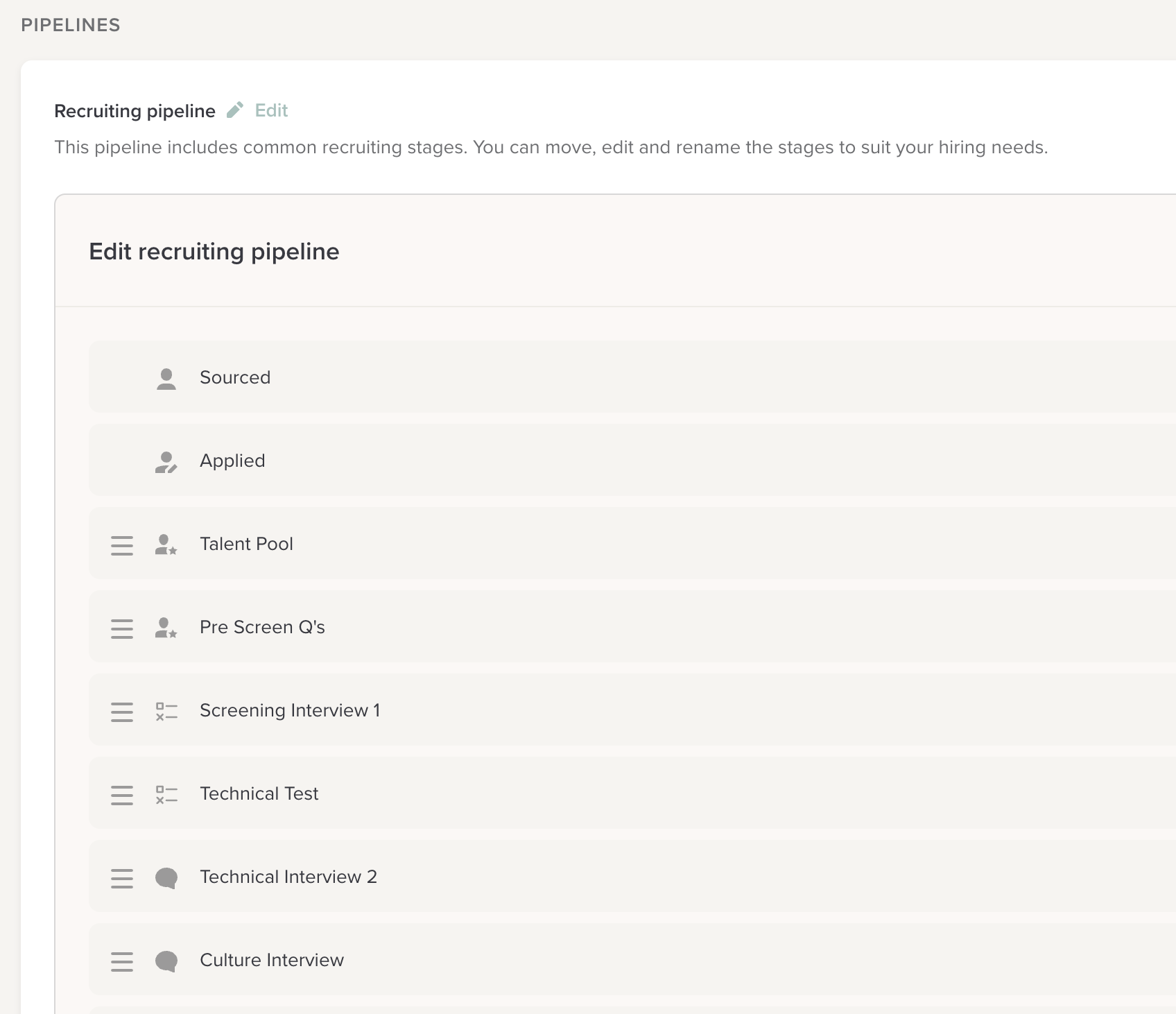
Designed a structured recruitment workflow using Workable with:
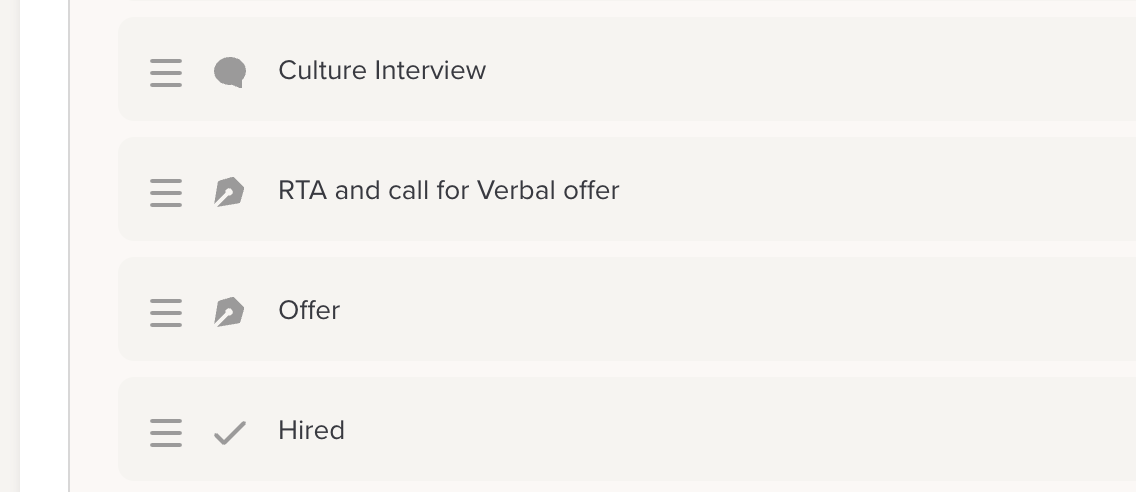
- Standardized hiring stages from sourcing through offer
- Automated candidate communications at key transitions
- Defined screening checkpoints before each interview round
- Interview progression controls to prevent stage-skipping
- Talent pool management for strong candidates not yet right for open roles
Pipeline Design
The hiring pipeline was structured to surface intent and fit progressively, with each stage gated by a clear evaluation criterion.
Automation Design
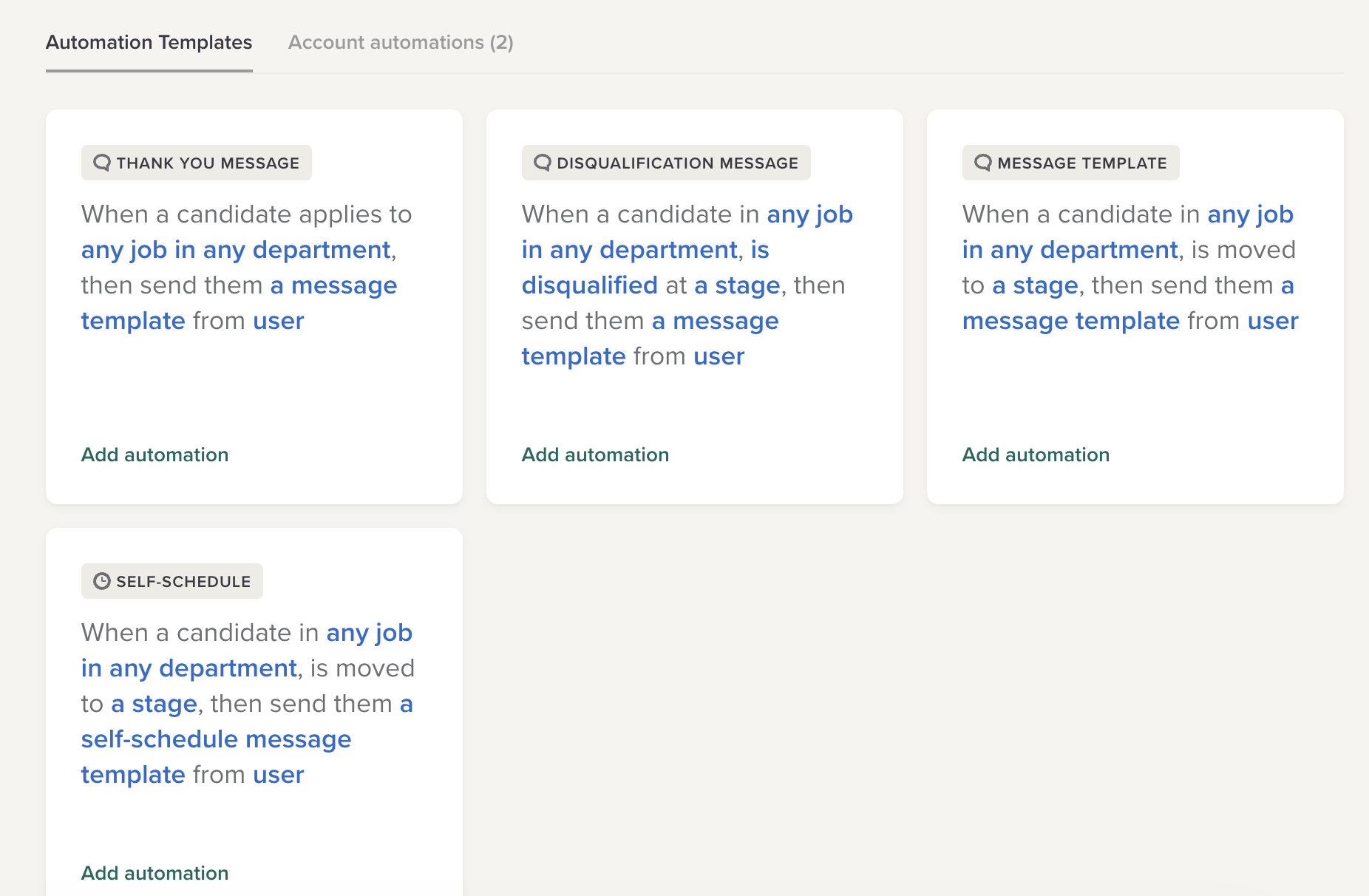
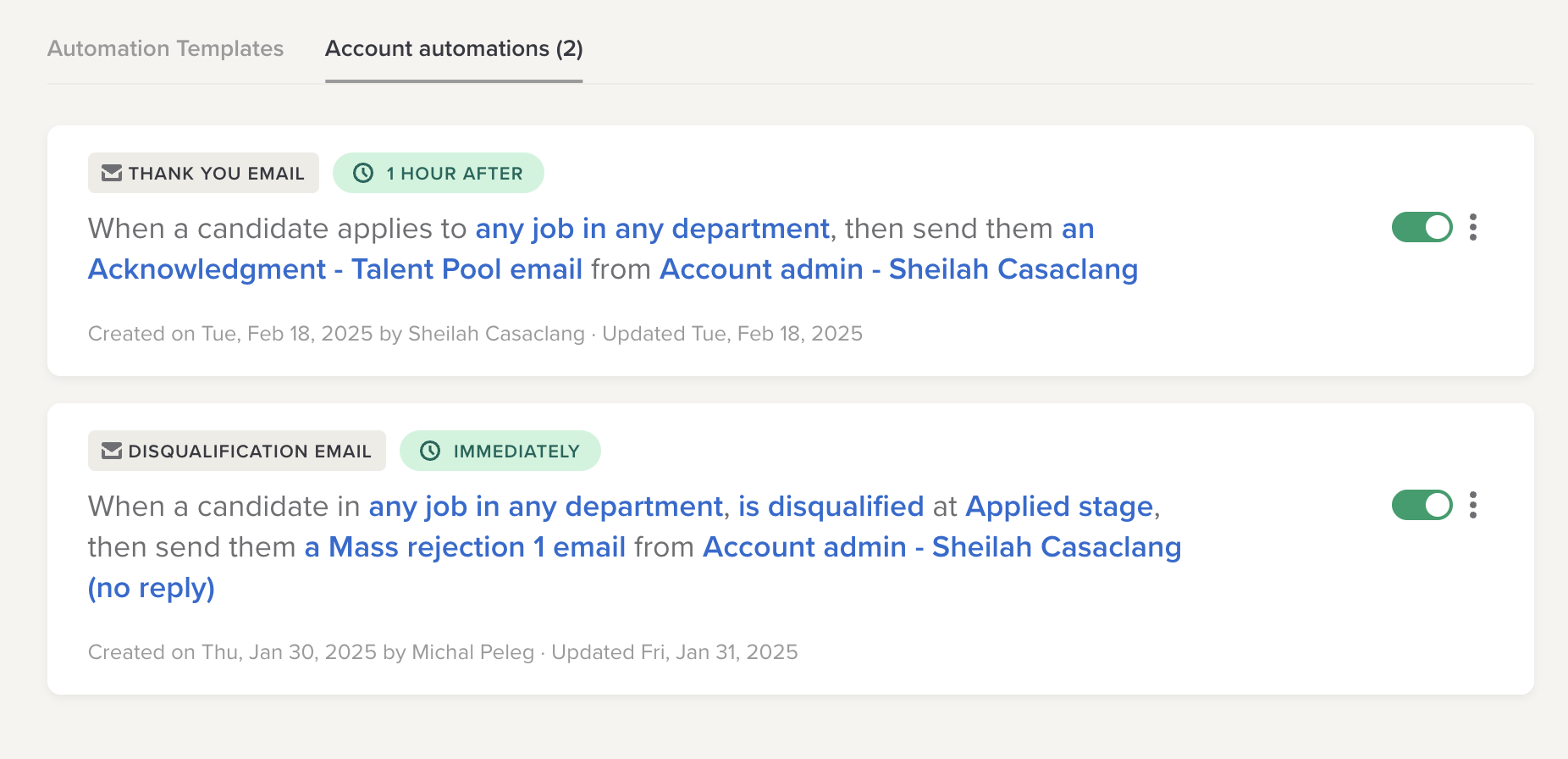
Candidate communication was automated at high-volume, low-judgment moments — freeing the team to focus on higher-stakes touchpoints while ensuring no candidate fell through a communication gap.
Outcome
Reduced manual administrative overhead, improved candidate communication consistency, and created a repeatable hiring process that scaled across multiple concurrent roles. Candidates received timely responses at every stage; the team spent less time on follow-up and more time evaluating fit.
Artifact 02 — Knowledge Architecture
Employee Handbook & Knowledge Architecture
A centralized source of truth for policies, procedures, onboarding resources, and operational guidance — structured around how employees actually navigate their work, not the org chart.
Challenge
Policies, procedures, onboarding resources, and operational guidance were spread across multiple locations with no consistent ownership or update cadence. Institutional knowledge lived in long-tenured employees' heads. New hires spent their first weeks triangulating conflicting information from Slack, old PDFs, and verbal hand-me-downs.
Approach
- Audited all existing documentation and classified by lifecycle stage, owner, and freshness
- Designed an information architecture organized around the employee journey — not departments
- Authored the employee handbook as the primary policy reference
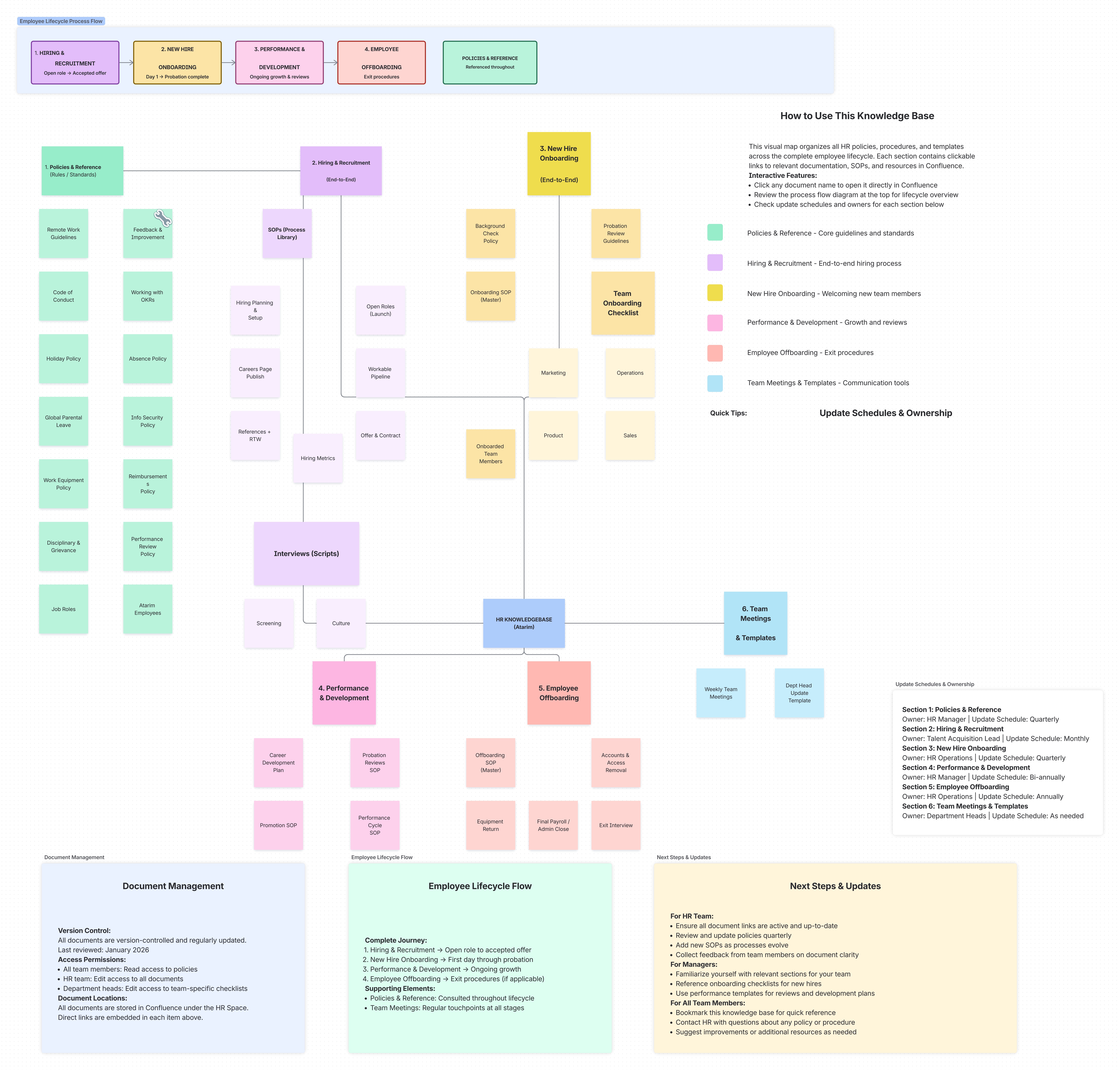
- Built a structured HR knowledge base mapping all resources, owners, and related processes
- Established governance: named owners, update schedule, and a version control process
Knowledge Base Architecture
The knowledge base was designed as a lifecycle map — tracing the full employee journey from recruitment through offboarding, with every resource, process, and owner anchored to a stage.
Outcome
Created a single source of truth for employee information that reduced dependency on tribal knowledge and supported faster onboarding. The handbook became the default reference in manager conversations and all-hands sessions. New hires reported higher confidence navigating their first 30 days.
Artifact 03 — AI-Assisted Operations
AI-Assisted Recruiting & Operations Toolkit
A practical framework for using AI as a force-multiplier in HR and ops work — identifying where AI reduces time-to-first-draft and where human judgment remains the irreplaceable input.
Design Principle
The tasks that matter most in ops — calibrating judgment, earning trust, navigating ambiguity — are irreducibly human. AI earns its place by absorbing the high-volume, pattern-driven work that crowds those out: drafting, summarizing, classifying, formatting.
Every workflow below is designed with that boundary in mind. AI accelerates the first draft; a human reviews, decides, and owns the output.
Use Cases by Function
🔍 Recruiting
- Job description drafting
Generate a complete JD from a role brief and must-have requirements. Review for accuracy and tone before posting. - Interview script generation
Build structured question sets mapped to specific competency areas defined in the scorecard. - Scorecard creation
Draft weighted evaluation criteria aligned to role requirements. Calibrate weights with the hiring team. - Candidate evaluation support
Summarize interview notes, flag evidence gaps, and draft rejection rationale from panel feedback.
📋 Documentation
- SOP drafting
Convert process notes or verbal walk-throughs into formatted, reviewable standard operating procedures. - Handbook updates
Rewrite policy sections for clarity, consistency, and tone. Preserve intent; improve readability. - Policy drafting
Generate first drafts from regulatory requirements, leadership intent, or industry benchmarks.
✉️ Communication
- Candidate outreach
Personalized sourcing and follow-up messages at scale — templated with merge fields, reviewed before send. - Interview summaries
Structured post-interview summaries formatted for hiring panel alignment and documentation. - Stakeholder updates
Concise pipeline status updates for hiring managers — consistent format, fast to produce.
🔎 Research
- Compensation benchmarking
Synthesize market rate data across sources into a structured summary for compensation review. - Role comparisons
Analyze similar roles across organizations to inform leveling, titling, and scope decisions. - Market research
Landscape analysis for talent market conditions, hiring trends, and candidate expectations by role.
Outcome
Reduced time-to-first-draft across the most common ops and recruiting deliverables — job descriptions, SOPs, interview scripts, policy updates — while maintaining full human review and decision-making at every step. Ops team capacity expanded without headcount. Quality improved on routine deliverables; humans focused on the work that required human judgment.
Artifact 04 — Performance Systems
Structured Interview & Hiring Calibration Framework
A repeatable evaluation system that makes interviewer judgment explicit, comparable, and improvable — replacing gut feel and post-hoc rationalizations with evidence-based hiring decisions.
Design Rationale
Inconsistent hiring decisions usually aren't a people problem — they're a process problem. When interviewers don't share a common framework, calibration becomes a debate about feelings rather than evidence. This framework standardizes what we're evaluating, how we score it, and how we reconcile disagreements — before they become bad hires.
Candidate Scorecard
| Competency | Weight | What we're looking for |
|---|---|---|
| Problem Solving | 25% | Approach to ambiguity, quality of reasoning, comfort with incomplete information |
| Communication | 20% | Clarity, structure, active listening, ability to explain complex things simply |
| Ownership | 20% | Evidence of initiative, concrete impact, accountability for outcomes |
| Technical Ability | 20% | Role-specific skills and depth — defined per role before interviews begin |
| Team Fit | 15% | Collaboration style, feedback orientation, alignment with how we work |
Interview Rules
- 01Evidence over intuition — every rating must cite a specific example from the conversation, not a general impression.
- 02Written feedback required — interviewers submit their scorecard before attending the calibration discussion. No exceptions.
- 03Hire / No Hire with explanation — a rating alone isn't a recommendation. Every submission ends with a clear stance and the one-sentence reason for it.
- 04Score independently — interviewers do not share feedback before submitting. Anchoring to someone else's view undermines the calibration entirely.
Calibration Process
Interviewers submit scorecards
Each interviewer completes their scorecard immediately after their session — within 24 hours at most. Ratings with no supporting evidence are returned for revision.
Hiring panel reviews independently
All submitted feedback is shared with the full panel before the calibration meeting. Panel members review without discussion — forming their own view before hearing others.
Hiring manager facilitates disagreement discussion
Ratings that differ by 2 or more points on any competency are discussed explicitly. The discussion focuses on what evidence each side is weighting — not on persuasion.
Final recommendation documented
Hiring manager records the final Hire / No Hire recommendation with a written rationale. This becomes the audit trail if the decision is ever revisited.
Outcome
Hiring managers reported greater confidence in decisions and fewer inconclusive panel outcomes. Promotion and hiring decisions became more defensible — grounded in documented evidence rather than retrospective justification. The framework also served as a coaching tool: patterns in scorecard disagreements surfaced gaps in interviewer training.